
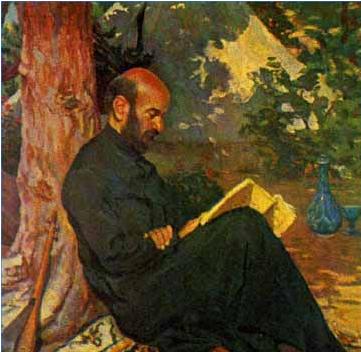

Enticing the Armenian Prince of Mogk with the promise of a peace deal, the Persian Pasha poisoned the valiant freedom fighter–that had come, on his Bedouin Horse, to the Persian Pasha in Jezireh– during a sumptuous banquet hosted by the usurping Pasha himself. The rage of the folk poetry and music is directed not towards the neighbouring people թ§Չ-Չin this case the Persiansթ§Չ-Չbut against their usurping ruler. Just like in the Epic of David of Sassoon.
In the Epic of Sassoun, when the orphan child DavidթԹ (having lost mother and father) refuses to suckle from the breast of any Armenian woman, his wise uncle Dzenov Ohan (Ohan the Vociferous) puts him on the back of his fatherթ§Չ-Չ§s horse Koorkik Jalal (Splendid Young Horse) and the horse takes him to the land of Mosul-Nineveh ruled by the Arabs, the rulers of Armenia of the day! There his father Maherթ§Չ-Չ§s Arab sweetheart breastfeeds the enfant Davidթ§Չ-Թ» This is the wisdom of genuine folk imagery. Mind you, the same David, when grown up, fights against the Arab Melik, his stepbrother but an invader of his ancestral homeland. Alas, some translators of the Epic haveթԹ omitted թԹ that part in their editions, betraying the original text.which luxuriates in the notion thatթԹ peoples are essentially brothers and sisters. They are abused by their oppressors to eventually force them fight each other, hence serve, in modern parlance, as cannon fodder, to safeguard the oppressors wealth, plundered from the oppressed peoples.
Komitas had just transcribed the Mogkats Mirza song, when the venerable poet Avedik Issahakian meets him in Etchmisdzin. Komitas enthusiastically sings the song to Issahakian, enchanting the poet with his trove. Issahian records down what Komitas told him about the song:
“This ancient song has come down to us from the heathen times. Observe how the lyrics and the tune are in compact unison. It has its brth in the high mountains, waterfall cascades and petulant rocks. It has burst out of the soul of our valiant forefathers. It is a song that Dzenov Ohan might have sungթԹ to David of Sassoun …”
թԹ թԹ
Here is my English translation of the poemթԹ of the Epic Song, Mogkats Mirza:
LAMENT FOR THE PRINCE OF MOGK –Transcribed by Komitas Vardapet(1869-1035)
(English translation by Khatchatur Pilikian)
It was Friday, becoming Saturday
In Malakiava it was a festive day,
When a letter arrived
From the town of Jezireh
It was handed over to the Prince of Mogk.
AlթԹ։s A thousand lament for the Prince of Mogk.
թԹ
He read with his sweet voice
But soon wrinkles besieged his eyes
And the Furies pulled down his chin
A red harvest coloured his face.
AlթԹ։s A thousand lament for the prince of Mogk
թԹ
He called upon the farmer of his lands:
թ§Չ-ժBring me fast my Bedouin horse
Place on her the saddle made of oyster shells
I am going on a journey
To the land of Jezirehթ§Չ-Թ,
AlթԹ։s A thousand lament for the prince of Moigk.
. . .
թԹ
(Eventually the Prince succumbs to the Pashaթ§Չ-Չ§s poison)
There came the Mogkites and assembled
They gathered around the Prince of Mogk
They carried him to the mountain cave
And left open the west-wind gate.
Do rest in Peace
For a thousand years.
The epic poem/songթԹ covers fourteenթԹ verses in total. I have translated the first three and the last, the 14th verse. I have sung also in 7 or 8 verses in special concerts. In the attached performance I have only sung the first three verses.
KhatchaturթԹ I. Pilikian
photo byթԹ թԹ
www.armenianmusicarch.com
Be the first to comment