

by Tracey Harnish on July 27, 2010
I never liked Gorkyթ§Չ-Չ§s work.թԹ When I was in art school I thought his paintings were grey and ugly.թԹ The forms and shapes seemed like distorted human forms.թԹ But Gorky seemed to be the favorite of my teachers when I was in art school.թԹ They all spoke of him with reverence, much more so than the more popular Jackson Pollack preferred by the students.
Going to see this show at MOCA, I had mixed feelings.թԹ What would it be like to see a lot of his work in person?թԹ Would I still dislike his work, rush through the museum and continue to wonder why other artists seem to love him so much?
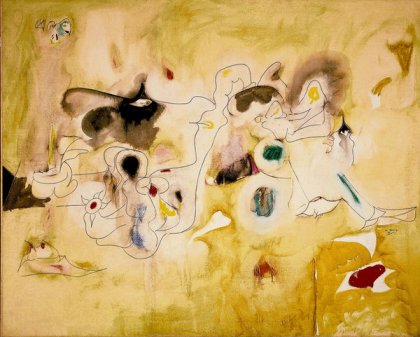
Seeing this show was like seeing a completely different artist. In the past I had probably really only seen a couple of his works in person. What I learned today was that his work is especially misrepresented in print. It must be a combination of the colors not being reproduced quite right and the loss of detail in print, because standing in front of a Gorky painting was a completely new experience for me. After the show I went into the bookstore and yep, the paintings reproduced in books, still looked like crap.
I was surprised at the thick impasto paint in the some of the earlier works. In a couple places it looked like it had been carved out. Gorky used a lot of matte white that was rough and uneven. Later paintings included palates of rich color, some very thinly painted with drips and watercolor like layering. Many of the thin black lines that he painted throughout his later work were elegant, reminding me of calligraphy in the way a line would move from thick to thin in places. Some of the gouache paintings were especially nice. They were small and the paint was layered neatly on forms that were a combination of organic and geometric.
There were plenty of the darker grey and brown paintings that I used to associate with Gorky but they faded into the background because so many of the other paintings were so vivid. It was amazing how by seeing the paintings in person, they had a completely different feeling. Instead of ugly, they are beautiful and subtle, rich with drawing and emotion.
Itթ§Չ-Չ§s interesting to know about Gorkyթ§Չ-Չ§s history because his life was so tragic.թԹ According to MOCAթ§Չ-Չ§s website, Gorky was born in Armenia in 1902. When he was just 13 he was a first-hand witness to the Turkish governmentթ§Չ-Չ§s Armenian Genocide of 1915 and his family along with many others, fled to the US in 1920.թԹ Settling in New York, Gorky was mostly a self taught painter but studied other artists and you can see the different stages he worked through in his earlier works: Paul Cezanne, Pablo Picasso, Fernand Leger and Joan Miro.թԹ In the 40թ§Չ-Չ§s he developed his own style after being befriended by a group of surrealists who influenced him greatly. His final years were filled with immense pain and heartbreak. His studio barn burned down, he underwent a colostomy for cancer, his neck was broken and his painting arm temporarily paralyzed after being in a car accident.թԹ Eventually his wife of seven years left him to purse an affair with a friend of his, taking their children with her. After so much tragedy Gorky hung himself in Sherman, Connecticut Sherman, in 1948, at the age of 44.
If you attend this show you will see the many phases Gorky worked through to become the innovative painter that other artists still love to this day.թԹ The mystery as to why he is so beloved by other artists was finally made clear to me.թԹ Itթ§Չ-Չ§s a show you have to see in person to appreciate.
culturemob.com/
Be the first to comment